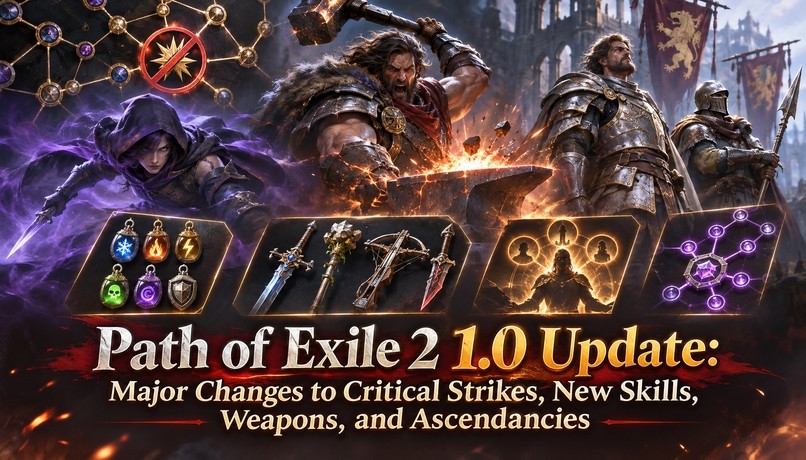
Path of Exile 2 1.0 is shaping up to be a major turning point for the action RPG, bringing substantial changes to combat mechanics, passive skill trees, character progression, and build customization. From the removal of critical strike chance nodes to the introduction of new weapon types, additional charm slots, and redesigned ascendancies, the upcoming update promises to make character building more diverse and rewarding.
These changes will affect both established players and newcomers, creating new opportunities to experiment with different playstyles. Understanding the most important Path of Exile 2 1.0 changes will help players prepare their builds and make better decisions when the update arrives.
Critical Strike Chance Removed from the Passive Skill Tree
One of the biggest changes in Path of Exile 2 1.0 is the complete removal of critical strike chance nodes from the passive skill tree. Critical strikes have become a common damage-scaling strategy for almost every type of build, including martial characters, spellcasters, and totem users. The developers want to prevent critical strike investment from becoming the default choice for every endgame character.
Under the new system, critical strike chance will primarily come from equipment rather than passive nodes. Weapon base types will therefore become much more important when designing critical-focused builds.
For example, daggers have a base critical strike chance of 15%, while swords have only 5%. This difference can significantly affect how efficiently a character scales critical strikes. Players will need to pay closer attention to their weapon choices and the natural critical strike potential of their spells.
Meanwhile, the passive skill tree will focus more heavily on improving damage outcomes, including critical strike damage. This creates a clearer division between equipment and passive investment: gear determines how frequently critical strikes occur, while passive nodes help increase their effectiveness.
The change could also make the Druid Oracle particularly interesting because of its Inevitable Criticals mechanic, which rerolls critical strike outcomes until a critical hit occurs.
Shroud Introduces Faster Movement and New Combat Possibilities
Another exciting addition is Shroud, a new shadow-based skill that allows characters to enter stealth and move rapidly through combat areas.
Shroud requires a dagger and is available as a level-one skill, meaning players do not necessarily need to choose the Shadow class to use it. It has a seven-second cooldown, but killing an enemy resets the cooldown. This creates opportunities to move quickly between enemy groups without waiting for traditional movement skills.
For example, a Warrior using mace attacks and Bone Shatter could equip a dagger in the secondary weapon set, activate Shroud to move forward, and then switch back to the primary weapon to eliminate enemies.
Shroud also provides temporary protection by making the character harder for enemies to detect. During its movement animation, players can avoid the usual movement slowdown, while enemies affected by the skill are blinded.
These features could make Shroud especially valuable for melee builds that need to close distances quickly. Its ability to reset after kills also encourages aggressive gameplay and creates a smoother combat rhythm.
Warriors Receive a Powerful New Anvil Skill
Warrior players will also have access to a new offensive ability called Anvil. This level-one skill allows players to drop a massive anvil onto enemies before striking it with melee attacks to trigger additional fiery explosions.
Unlike some existing Warrior abilities, Anvil does not require Glory. It has a six-second cooldown and can be used alongside familiar skills such as Bone Shatter and Rolling Slam.
The skill offers an interesting alternative for clearing groups of enemies. Players can place the anvil in the middle of a large pack, trigger its initial impact, and follow up with melee strikes to create further explosions.
Its mechanics also leave room for experimentation across different weapon combinations. Mace users can incorporate Anvil into traditional melee rotations, while other weapon-based builds may find creative ways to take advantage of its attack interactions.
Although the cooldown may require some planning, Anvil looks like a promising addition to the Warrior’s early-game and endgame toolkit.
Six Charm Slots Create More Defensive Flexibility
Charm customization is receiving a significant upgrade in Path of Exile 2 1.0. Instead of the current three slots, players will be able to equip up to six charms.
This change provides considerably more flexibility when preparing for different encounters. Players currently have to prioritize common threats such as stun, freeze, and ignite, sometimes leaving themselves vulnerable to other damage types and negative effects.
With six slots available, characters can potentially equip additional defensive charms to counter lightning damage, chaos damage, and other dangerous effects.
The change could be particularly interesting for the Shaman ascendancy. Its passive mechanics provide 40 additional Spirit for each empty charm slot. If this value remains unchanged, leaving all six slots empty could potentially provide 240 bonus Spirit.
However, the final balance of this interaction remains something players will need to evaluate when the update becomes available. Regardless, additional charm slots should make defensive planning and unique charm combinations more interesting.
New Weapon Base Types Bring More Build Diversity
Path of Exile 2 1.0 is introducing dozens of new weapon base types with unique properties and abilities. These additions could fundamentally change how players evaluate equipment.
Rather than simply choosing weapons with the highest attack speed, physical damage, or critical strike chance, players will have more reasons to consider special weapon effects.
Some notable examples include:
- Runic Shortsword: Provides additional maximum sockets, creating more customization opportunities.
- Chieftain Sword: Gives buried blades an ancestral boost.
- Specialized Crossbows: Certain weapon types provide additional grenade projectiles or extra bolts.
- Ballista Totem Crossbow: Can provide an additional Ballista Totem, opening new possibilities for totem builds.
- Druidic Staff: Features a channeling ability that launches a massive boulder, gaining damage and area of effect as it charges.
- Bejeweled Swords: Allow jewels to be inserted into weapons instead of relying exclusively on traditional runes.
- Rogue Weapons: Can increase Shade limits, supporting additional shadow-based mechanics.
These are only some examples of the new equipment options. With approximately 10 to 50 new base types expected across different weapon categories, finding the right weapon could become a more meaningful part of character progression.
Even a powerful white weapon base could become valuable if it has the exact properties required by a particular build. This should also create new opportunities for crafting and trading.
Knight Ascendancy Introduces the Squire Mercenary
The Knight ascendancy brings another interesting development through its Squire mechanic, which allows players to recruit and equip a mercenary companion.
The Squire can use different melee weapon types and corresponding skills. A spear can provide access to spear abilities, while a mace allows the companion to use slam skills. Sword-based equipment can also support skills similar to those used by the player.
One particularly interesting feature is that the Squire can equip unique items.
This creates opportunities for powerful combinations involving different damage types. For example, a Cyclone-focused Duelist using bleed mechanics can combine banners that create blood pools with equipment that leaves burning ground behind. Additional unique boots can introduce lightning effects, allowing multiple damage types to work together during combat.
The Knight also has access to Honorbound, a mechanic that generates Valor around unique enemies and bosses or when using Glory through banners. Reaching maximum Valor triggers waves of justice that provide additional damage.
Combined with Cyclone, banners, and the Squire’s equipment, these mechanics could create an exciting playstyle built around continuous damage and powerful boss encounters.
Passive Skill Tree Rework Expands Build Customization
The passive skill tree is receiving several important structural improvements.
One notable change is the relocation of jewel sockets. Instead of being scattered throughout the main passive paths, jewel sockets will now appear within clusters of related passive nodes.
This should make planning more efficient. Players can invest in a specific group of poison, bleed, or other damage-related nodes while gaining access to nearby jewel sockets without taking unnecessary detours across the tree.
The number of specialized passive nodes is also increasing. Poison builds, in particular, are receiving significantly more options, especially around the Shadow section of the tree.
Some new passives provide additional poison magnitude based on the number of impales affecting an enemy. Since players can stack up to 20 impales, these interactions could create substantial damage bonuses.
Similar mechanics are being introduced for bleed builds, giving Duelists more opportunities to develop dedicated bleeding setups.
Totem builds are also receiving additional passive support, although the full extent of these changes remains to be seen.
Mercenary Reloading Becomes More Convenient
The Mercenary class is receiving an important quality-of-life improvement to its weapon reloading system.
Previously, players had to stop attacking to reload their crossbows after exhausting their available ammunition. In the updated system, reloading happens automatically in the background when switching weapon sets.
This means Mercenary players can fire their primary weapon, switch to a secondary weapon to use a supporting ability, and then return to the first weapon once it has reloaded.
The change should make combat smoother and reduce the need to invest heavily in reload speed. It also encourages players to combine different weapon sets and supporting abilities instead of interrupting their rotations to reload.
More Ascendancy Options Could Arrive Before Release
Although many class improvements have already been revealed, some ascendancy options are still unfinished.
The Druid and Ranger are both missing an additional ascendancy option. The developers have indicated that they are working toward completing these options before the 1.0 release, although their arrival is not guaranteed.
Potential possibilities include more specialized shapeshifting mechanics for the Druid or additional elemental and beast-focused progression paths.
These missing ascendancies could provide even more build diversity if they become available. Players will need to wait for further announcements and the complete patch notes to understand exactly how every class will change.
Final Thoughts: Path of Exile 2 1.0 Could Transform the Endgame
Path of Exile 2 1.0 is introducing much more than a collection of new skills and equipment. The removal of passive critical strike chance, expanded charm slots, redesigned passive clusters, new weapon base types, and additional ascendancy mechanics all point toward a more specialized approach to character building. Players will need to think carefully about equipment choices, defensive preparation, and skill combinations rather than relying on familiar damage-scaling strategies. Preparing the right equipment and maintaining enough resources for crafting and trading will be essential as new builds emerge. Whether you are experimenting with Shroud, developing a powerful bleed Duelist, or exploring the Shaman’s Spirit mechanics, having sufficient resources can make progression easier. If you want to prepare your character for the upcoming changes, you can also explore options to buy Path of Exile 2 Currency and get ready for the new challenges ahead.