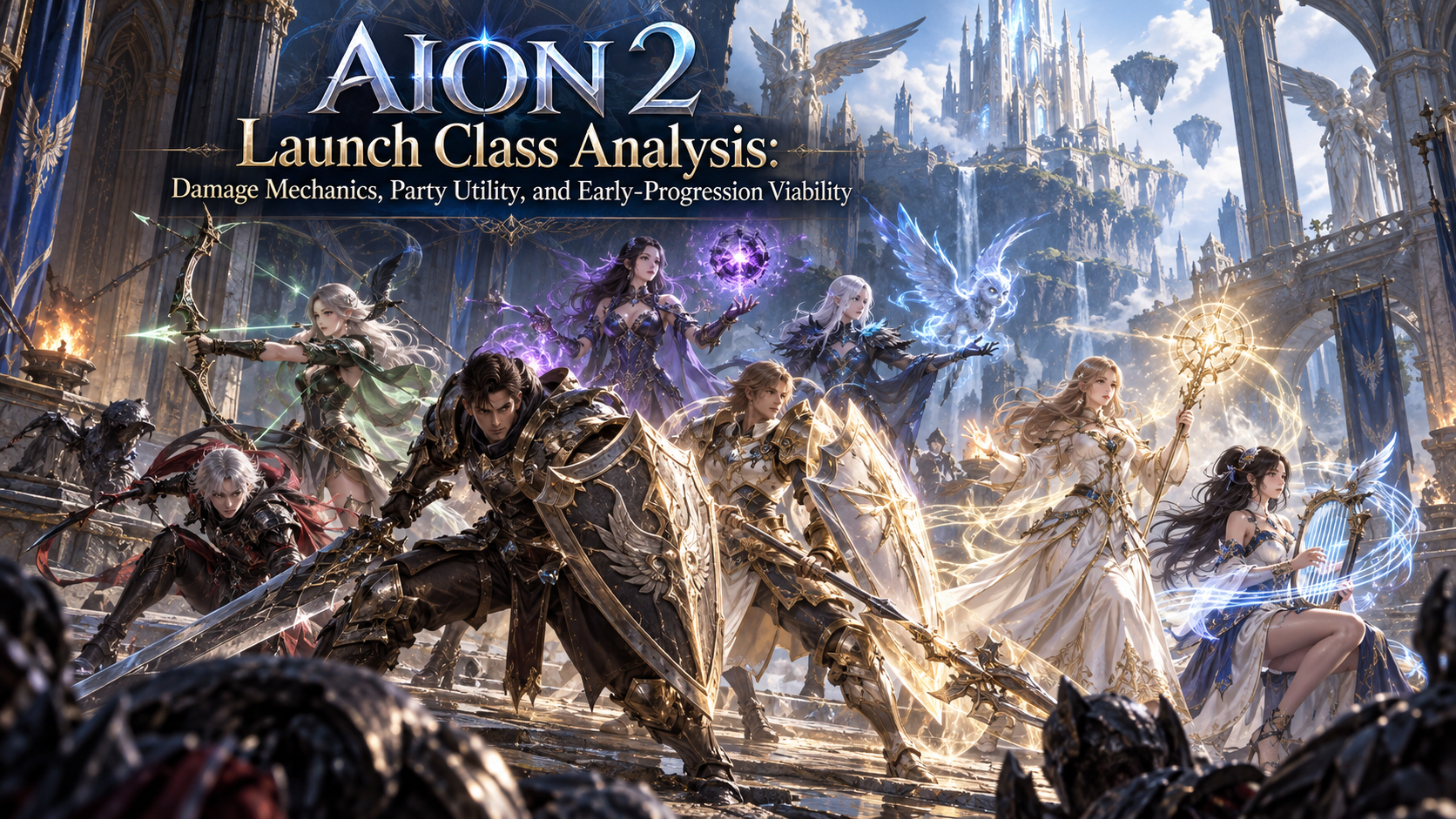
Choosing a first class in Aion 2 determines how you handle quests, earn Aion 2 Kinah, fight enemies, and contribute to party content. The global launch roster contains eight classes: Gladiator, Templar, Assassin, Ranger, Sorcerer, Spiritmaster, Cleric, and Chanter. Each class has a different combat responsibility, so the most useful way to choose a starting character is to match its combat pattern with the type of progression you plan to play.
Aion 2 uses active combat built around positioning, timing, movement, defensive reactions, and skill combinations. That makes isolated damage numbers less useful when choosing a first character. A class that performs well on a stationary target may require much more execution in a real encounter, while a tank, healer, or support class can provide value that does not appear on a personal DPS meter.
Start With the Role You Want to Play
Before spending time on equipment or progression resources, decide what you want your character to contribute. The launch classes cover dedicated tanking, melee and ranged damage, healing, and hybrid support.
| Class | Main Role | Early-Game Focus |
| Gladiator | Tank / DPS | Melee damage and frontline flexibility |
| Templar | Tank | Threat control and active defense |
| Assassin | Melee DPS | Positioning and precise attack windows |
| Ranger | Ranged DPS | Distance, movement, and sustained attacks |
| Sorcerer | Magic DPS | Burst damage and spellcasting windows |
| Spiritmaster | Ranged / Solo DPS | Solo progression and summon-based combat |
| Cleric | Healer | Recovery and party survival |
| Chanter | Support / Hybrid | Party utility and flexible combat |
NCSoft’s official class descriptions establish these different identities, including Gladiator’s area-focused attacks, Templar’s main-tank role, Assassin’s precision-oriented combat, Ranger’s ranged specialization, Sorcerer’s damage focus, Spiritmaster’s solo orientation, Cleric’s improved offensive capability, and Chanter’s multiplayer support role.
Gladiator: Choose Flexibility Over Specialization
Gladiator is a strong choice for players who want melee combat but do not want their character to be limited to a single function. Its area-focused attacks are useful when several enemies are within range, while its frontline capabilities allow it to contribute to tanking situations.
For early progression, learn to separate damage positioning from tank positioning. When dealing damage, maintain safe melee uptime without unnecessarily taking enemy attacks. When acting as a frontline character, give greater priority to enemy control and positioning.
Gladiator progression priorities
- Learn how many enemies you can safely engage at once.
- Practice maintaining melee range without standing in avoidable attacks.
- Use area attacks effectively against grouped targets.
- Adjust your defensive behavior when performing a frontline role.
- Invest your early resources into the equipment and skills that match your primary role.
Gladiator is therefore a useful choice for players who want one character capable of participating in different types of group content without making dedicated tanking their only responsibility.
Templar: Build Around Frontline Control
Templar is the clearest dedicated tank choice in the launch roster. Its job is to establish enemy control, maintain a stable frontline, and reduce pressure on the rest of the party.
The class also benefits from active defensive mechanics. Perfect Shield Block and Perfect Parry were introduced as part of Aion 2’s class and combat updates, reinforcing the importance of responding to attacks rather than simply absorbing incoming damage.
Basic Templar encounter routine
- Establish control when the encounter begins.
- Position enemies so the party has predictable attack space.
- Watch enemy attacks instead of focusing only on your own skill rotation.
- Use defensive mechanics against appropriate attacks.
- Correct enemy positioning when the encounter moves.
- Return to offensive actions after the immediate defensive requirement is handled.
Templar is a good fit for players who enjoy having a clear responsibility in party content. The trade-off is that positioning errors can affect other players, so encounter awareness should come before damage optimization.
Assassin: Turn Positioning Into Damage
Assassin is designed around precise close-range combat. The class suits players who enjoy moving around enemies, finding attack opportunities, and maintaining pressure from melee range.
The biggest early progression lesson is learning when not to attack. Staying beside an enemy simply to preserve damage uptime can result in avoidable damage and interrupted skill sequences.
Assassin combat loop
Move into the correct attack position, complete the appropriate attack sequence, respond to the enemy mechanic, then return to melee range when the opening is safe. Practice this cycle during normal progression before relying on it in harder group encounters.
This makes Assassin more dependent on execution than a ranged class that can often maintain greater distance from immediate threats.
Ranger: Maintain Distance Without Losing Uptime
Ranger provides the most direct ranged-damage approach among the physical damage classes. Its long-range identity gives players more space to react to enemy movement and dangerous areas.
During early progression, use distance to create reaction time rather than treating it as a reason to stand still. Establish a safe position, attack consistently, move when the encounter demands it, and resume attacking immediately after repositioning.
Ranger priorities
- Keep an appropriate distance from enemies.
- Maintain attacks while moving when the situation allows.
- Avoid standing in dangerous areas simply to preserve one attack.
- Learn how much movement is required before returning to your normal attack position.
For players learning Aion 2’s combat system, Ranger provides a practical way to practice movement and attack timing without taking on the same close-range requirements as Assassin.
Sorcerer: Protect Your Casting Windows
Sorcerer specializes in powerful magical attacks and is most effective when it can maintain useful casting opportunities. Its performance therefore depends on more than the theoretical strength of individual spells.
Before starting a longer offensive sequence, check the encounter position and upcoming mechanics. Moving early can prevent a larger interruption later.
Sorcerer priority order
- Establish a safe casting position.
- Identify upcoming movement requirements.
- Use stronger attacks during suitable damage windows.
- Reposition before dangerous mechanics reach you.
- Resume casting as soon as the position becomes safe.
Sorcerer works particularly well for players who prefer ranged magical combat and are comfortable planning movement around offensive windows.
Spiritmaster: Build Around Independent Progression
Spiritmaster has a distinct solo-oriented identity and uses summon-based combat. This makes it a natural option for players who expect to spend considerable time questing or progressing independently.
During solo content, use the class’s summon mechanics to maintain pressure while you concentrate on positioning and enemy behavior. When entering group content, adjust your priorities according to the encounter instead of assuming that solo performance automatically translates into the same group role.
For solo progression
- Keep your summon-based abilities active when appropriate.
- Maintain safe positioning while enemies are engaged.
- Use your own attacks to supplement sustained pressure.
- Save defensive responses for mechanics that can interrupt your progression.
Spiritmaster is particularly suitable for players who want their first character to remain comfortable outside organized groups.
Cleric: Make Survival the First Priority
Cleric is the launch roster’s dedicated healing class. Its offensive capabilities allow it to contribute damage, but difficult group encounters should still be approached with party survival as the first priority.
Use a simple priority system:
- Party survival first
- Defensive support second
- Personal damage third
When the party is healthy and the encounter provides a safe opening, contribute offensive skills. When several allies require recovery, stop chasing personal damage and return to healing responsibilities.
This role also makes Cleric useful for players who expect to participate regularly in group content. Your value does not depend on competing with DPS classes on a damage meter.
Chanter: Adjust Your Contribution to the Party
Chanter occupies a more flexible support position. Its multiplayer-oriented design allows it to contribute to both party support and combat, making the class suitable for players who prefer improving the group’s overall performance rather than concentrating entirely on personal DPS.
Your priorities should change according to party conditions.
| Party Situation | Chanter Priority |
| Allies under heavy pressure | Support and recovery |
| Party is stable | Add offensive contribution |
| Difficult encounter mechanic | Preserve utility for the dangerous phase |
| Solo progression | Increase offensive usage when safe |
This makes Chanter especially useful for players who enjoy reacting to what the group needs instead of following exactly the same combat sequence in every encounter.
Match Stigma Skills to Your Actual Role
Stigma is another part of Aion 2’s class customization. A major class update introduced new Stigma skills for the launch classes, including Fracturing Rush for Gladiator, Battlefield Banner for Templar, Barrier Spell for Chanter, Reincarnating Touch for Cleric, Command: Proxy for Spiritmaster, Hibernation for Sorcerer, Shadowstep for Assassin, and Supporting Fire for Ranger.
Do not choose Stigma options only because a particular setup produces a larger damage number in an isolated test. Your choice should support the role you actually perform. A Templar needs defensive and frontline value, while a Cleric or Chanter may gain more practical benefit from options that support their party responsibilities.
Pick Your First Class by Your Main Activity
Use your intended activity as the final filter rather than trying to identify one universal best class.
For solo questing: Spiritmaster is a natural fit because of its solo-oriented design. Ranger also provides a straightforward ranged combat pattern.
For dedicated tanking: Templar is the clearest choice because its class identity centers on main-tank responsibilities.
For flexible melee play: Gladiator is suited to players who want damage with additional frontline capability.
For precision melee DPS: Assassin is appropriate if you enjoy close-range positioning and active execution.
For ranged physical damage: Ranger offers a direct ranged combat loop with more distance from enemies.
For burst-oriented magic: Sorcerer is the natural choice for players who prefer powerful spellcasting.
For dedicated healing: Cleric is the clearest option for players who want party recovery to be their main responsibility.
For hybrid support: Chanter is suited to players who want to change their contribution according to party conditions.
Manage Early Resources Before Chasing Endgame Builds
Once you select a class, avoid spreading your early enhancement materials and currency across multiple characters without a clear reason. A new character benefits more from a coherent set of usable equipment and skills than from several partially developed setups.
Aion 2 also has different forms of Kina, including regular Kina and Kina (Bound). Regular Kina can come from activities such as monster hunting and player trading, while Kina (Bound) has separate acquisition sources. Keep this distinction in mind before spending resources because not every form of currency can be treated identically.
If you use cheap Aion 2 Boosting as an optional way to save time on progression, keep the service separate from your actual class development decisions. Your character still needs an appropriate equipment setup, Stigma choices, and understanding of its role before moving into content that requires active combat and party coordination.
After your first setup is ready, follow a simple progression cycle: complete available progression content, upgrade equipment that directly supports your class, refine Stigma choices, and practice the mechanics of the next group activity. Tanks should focus on enemy control and defensive timing, damage dealers should protect their uptime without ignoring mechanics, and healers or support classes should keep the party stable before adding extra damage.
When the next upgrade becomes available, prioritize improvements that strengthen your primary role instead of copying a damage ranking from another class or region. The global launch roster is built around eight distinct classes, and the most reliable first character is the one whose combat responsibilities you can execute consistently across the content you actually plan to play.